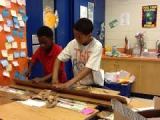
What has more than 25,000 participants in 10 countries and inspires creative play with things usually thrown away? The Global Cardboard Challenge! It is that time of year again, and this time I hope I’ve finally managed to post the information in plenty of time to use it. Inspired by the YouTube video sensation Caine’s … Continue reading
Filed under Lesson Ideas …
School of Doodle
Not long ago I wrote about how depressed I was by a Washington Post article titled, “Can Kickstarter save arts education?” It was full of gloomy statistics: Nearly one in 10 U.S. secondary schools has no music program. Eleven percent don’t teach art. More than half have cut theater. Nine in 10 have cut … Continue reading
How is That Billboard like a Squid? Biomimicry and Design
One of the classic questions in the creativity strategy Synectics is “What animal is like….?” Or “What in nature is like….?” The problem at hand is compared to something in nature that solves a similar problem. There is wisdom in nature. You probably all know the story of Swiss inventor George de Mestral, whose examination … Continue reading
Jimmy Fallon Does Morphological Synthesis
I’ll admit it—Jimmy Fallon is bad for my sleep cycle. My late-night theatrical husband returns home right about Fallon-time and the temptation to watch just for a while….well, let’s just say I sometimes succumb. Recently, while watching Fallon’s “Wheel of Musical Impressions” with Adam Levine, I realized I was seeing a unique—and very funny—use of … Continue reading
Lost Ladybugs and Blooming Scientists
One of the great challenges of helping students envision creativity in science is teaching science in ways that are more like, well, science. So much of science education is prepackaged in ways that are designed to make the questions clear and the results predictable—conditions actual scientists rarely experience. And besides, where’s the fun in giving … Continue reading
LEGO-tastic!
One of the joys (and time-wasting dangers) of the web is that you never know where an interesting link will lead. For me, today’s exploration involved LEGOs. It started when a friend sent a link to 50 States of LEGO, a creation of photographer Jeff Friesen, with LEGO scenes representing (naturally) each of the 50 … Continue reading
M I Curious? You Bet!
The M I Curious series on my local Public Radio station is a cooperative exercise in problem finding. Modeled after the Curious City series at WBEZ in Chicago, M I Curious asks, “What do you wonder?” It invites listeners to submit questions, puts the questions to a vote, and then selects those for investigation. It … Continue reading
Unbored All Summer Long
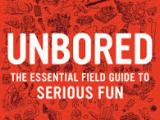
If I had to spend all summer with a group of kids and only one book, I know what I’d pick: Joshua Glenn and Elizabeth Foy Larsen’s Unbored: The Essential Field Guide to Serious Fun. This book is a marvel. It is full of activities, experiments, ideas to explore and plans to change the world. … Continue reading
How Do Scientists Think?
When I was in school we learned—or thought we learned—how scientists worked. Scientists, we were told, followed the 5-step scientific method. First they came up with a question, then they designed an experiment, collected data, and drew conclusions to answer the question. I can easily envision my scientist friends shaking their heads and saying, “If … Continue reading
A Poke in the I for Poetic Fun
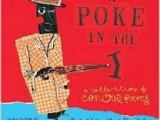
I love concrete poetry. The combination of poetry and art speaks to me—and I love the way it gives students with differing strengths a chance to shine. Concrete poetry is the graffiti of the poetry world—its messages as much graphic as literary. Recently I ran across a wonderful collection of concrete poems for all ages, … Continue reading